Clinic appointment conversion: from treatment page to booked visit
The click is paid for, the page gets read, and the appointment still goes to another clinic. A framework for the steps in between, and for working out what each booked appointment costs you.
- The booking is won or lost on three open questions. Before committing to a date, a patient wants to know whether to trust the clinic, what it will cost and how much they are signing up for.
- A first visit from an ad and a third visit are different jobs. The first-time visitor needs proof and a price range; the returning visitor needs dates and the shortest route to a slot.
- The booking step should match the treatment. Use direct online booking where no assessment is needed, a short consultation where it is, and keep a phone option visible.
- Measure cost per booked appointment, not cost per enquiry. Count online and phone bookings together and keep enquiries as a separate step, or the number will mislead you.
A patient who has read your treatment page has already decided the treatment interests them. What they have not decided is whether to book it with you. That second decision is where most clinic websites lose the visitor, and it turns on three things the page often leaves open: trust in the clinic, a clear idea of the price, and a next step that does not ask for too much commitment.
That makes clinic appointment conversion a different problem from a checkout or a demo form. The conversion event here is a booked appointment: a date and a time in the diary. An enquiry, a callback request or a brochure download is a step before that, and this article keeps the two apart throughout.
What follows is a practical framework for clinics and clinic groups that already buy traffic: where visitors drop, what a first-time visitor needs against a returning one, how to handle price and proof, how to build the booking step, and how to calculate cost per booked appointment. It sits inside our wider guide to conversion rate optimization.
Where patients drop between treatment page and booking
The path has four steps: the ad or search click, the treatment page, the booking step and the booked appointment. Each gap between them loses people for a different reason, and each needs a different fix.
The first gap is message match. Someone who clicks an ad for one treatment and lands on a general services page leaves quickly. That is a campaign and landing page problem, and it is covered in our piece on how conversion rate changes CPL and CPA.
The second gap, from treatment page to booking step, is where the decision is made. The visitor is on the right page and interested enough to read. What stops them is one of three open questions: can I trust this clinic with my body or my child’s teeth, what is this going to cost me, and what am I signing up for if I press this button. A page that describes the treatment well and answers none of the three reads like a brochure, and the visitor goes back to compare other clinics.

The third gap is inside the booking step: too many fields, no visible dates, a request for a deposit with no explanation. It is the easiest gap to see in analytics and usually the smallest of the three in absolute numbers, because far fewer people reach it.
A sitewide conversion rate hides all of this. It blends existing patients rebooking a hygiene visit with strangers from a paid campaign, which is why industry conversion benchmarks are a weak guide for a single clinic. Split the path by step first, then decide whether the problem is the traffic or the website.
What first-time and returning visitors need
Two people on the same treatment page can be at opposite ends of the decision. A first-time visitor from an ad knows the treatment name and the promise in the ad, and nothing about the clinic. A returning visitor who has read three treatment pages already knows the clinic, has compared options and is close to choosing. Showing both the same call to action wastes one of them.
For the first-time visitor, the page has to earn the right to ask. Lead with who will treat them and their qualifications, a price range, and what happens at the first visit. The next step should be small: a short consultation, a callback, or a question answered. Asking this visitor for a long form or a deposit is the pattern behind visitors who are not ready to commit.
For the returning visitor, the same content is now in the way. They need available dates, a clear way to pay and the shortest route to a slot. Sending them back through an introduction and a generic enquiry form adds a delay at the moment they were ready to book.
| Visitor | Main open question | What to show first | Next step to offer |
|---|---|---|---|
| First visit from an ad | Can I trust this clinic? | Practitioner credentials, price range, first-visit outline | Consultation or callback |
| Returning, several treatment pages read | When can I come, and how do I pay? | Available dates, payment options | Direct booking of a date and time |
| Existing patient | How do I rebook quickly? | Booking link or patient login | Direct booking |
The page content can stay the same for everyone while the next step changes with the visitor.
You can do part of this by hand: separate landing pages for paid campaigns, and a booking shortcut in the header for returning and existing patients. Doing it per visit is what Pathmonk is built for. It reads behaviour during the session, such as navigation, scroll and time on page, without third-party cookies, estimates how close the visitor is to a decision, and shows a small on-page prompt (a microexperience) with the next step that fits. Results are measured against a control group. The health and wellness page describes how this applies to clinics.
Price and financing transparency
Price is the question clinics most often leave unanswered, and for an elective or self-funded treatment it is the one the patient cares about first. “Contact us for pricing” turns the price into a reason to make contact, and many visitors will compare other clinics before they do that.
The data on cost information is thin but points the same way. In Experian Health’s State of Patient Access survey, published in April 2025, 41% of patients said they had received a cost estimate before care, up from 29% in 2022. That is a US survey of insured care, so treat it as a sign that most patients still arrive without knowing the cost, not as a benchmark for a private clinic elsewhere.
You rarely need an exact figure on the page. You need enough for the patient to decide whether to take the next step:
- A range, with what it includes. State whether the consultation, follow-up visits and any materials are part of it.
- What moves the price. If the total depends on an assessment, say so, and state what the assessment costs.
- How it can be paid. If you offer staged payments or financing, show it next to the price, with the provider and terms your financial rules require.
- What insurance or public cover applies, if any, in one sentence.
Financing changes the question from “can I afford this” to “can I afford this per month”, which is why it belongs beside the price and not on a separate page. Consumer credit is regulated in most countries, so have the wording checked before it goes live.
- A range for the treatment
- What the range includes
- Whether an assessment is needed
- What the assessment costs
- Staged payments or financing, if offered
- Insurance or public cover, if any
Proof that is allowed and credible in healthcare
Trust is the first of the three questions, and healthcare is the sector where the usual proof toolkit is most restricted. Patient testimonials and before and after images are regulated differently by country, by regulator and sometimes by profession or treatment type. In some places they are restricted or prohibited in advertising; in others they are allowed with conditions. Check the rules that apply to your clinic, or ask your adviser, before you publish any of them. Nothing here is legal advice.
The practical consequence is that the strongest proof on a treatment page is usually the kind anyone can verify, and it is often missing:
- Practitioner names, qualifications and registration numbers
- Clinic registration or inspection status, with a link to the register
- Years in practice and the treatments each practitioner provides
- Ratings shown on an independent review platform
- What happens at the first visit, step by step
- Patient testimonials on your own pages and in ads
- Before and after images
- Statements about results, success or satisfaction
- Comparisons with other clinics
- Offers, discounts and time-limited promotions
Put the verifiable proof where the decision happens. A practitioner’s name, qualification and registration next to the treatment description does more than a credentials page nobody opens. A link to the public register lets a careful patient check for themselves. A plain description of the first visit (how long, who they will see, what is decided there) removes the fear of the unknown, which a first-time visitor rarely says out loud.
Keep claims about outcomes out of the conversion layer. A promise of a result is a medical claim, it is the kind of statement regulators look at first, and it is not what makes a hesitant patient book. What they want is confidence in who will treat them and clarity about what happens next.
The booking step: form, phone and consultation
Patients expect to book without calling. In Experian Health’s 2025 survey, 80% of patients said they want to schedule appointments at any time from home or a mobile device, while 54% of providers offered self-scheduling. The survey covers US patients and providers, and the press release does not give the sample size, but the direction is hard to argue with: a clinic that only takes bookings by phone during opening hours is closed to visitors who decide in the evening.
Once a visitor starts a form, a large share do not finish. Zuko’s 2025 form benchmark, drawn from the forms its own customers track, reports a completion rate of 44.37% for healthcare forms across 727,492 sessions (49.87% on desktop, 40.82% on mobile), against 51.71% for all forms. This is vendor data covering every kind of healthcare form, not only appointment forms, so use it as a reason to measure your own form and not as a target.
Form length
Ask only for what is needed to hold the slot: name, a contact method, the treatment and a time. Medical history, insurance details and consent forms can be collected after the booking is confirmed, through the channel your privacy rules require. Every extra field at this point is a cost paid by the visitors least sure about booking.
Phone and online booking
Offer both, and track both. Some patients want to talk to a person before a first visit, and some treatments need a conversation. Keep the phone number visible on treatment pages and in the booking step, use call tracking so phone bookings can be tied back to the campaign, and make online booking show real availability and not a “preferred time” request that someone answers the next day.
Consultation or direct booking
Use direct booking when the patient can choose the treatment and its price without an assessment. Use a short consultation when the plan or the price depends on an examination, and state its price and length next to the button, including when it is free.
Show real dates and times. Ask only for what is needed to hold the slot.
Offer a short consultation, in person or by video, and state its price and length.
| Booking option | Fits when | Watch for |
|---|---|---|
| Direct online booking | Standard treatments with a known price, returning and existing patients | Showing no real availability, asking for clinical details up front |
| Consultation booking | Treatments that need an assessment, first-time visitors | Not stating the price or length of the consultation |
| Phone or callback | Patients with questions, complex or higher-priced treatments | Calls that are not tracked, slow callbacks outside opening hours |
| Enquiry form | Questions that are not yet about a date | Counting it as a booking before a date and time are confirmed |
Common mistake: reporting enquiries as bookings. A “contact us” submission is counted as a conversion in the ad platform, the campaign looks efficient, and nobody checks how many of those enquiries became an appointment. Report the enquiry as its own step and optimise campaigns towards the booked appointment.
How to measure cost per booked appointment
The number that tells you whether paid traffic is working is cost per booked appointment: paid spend for a period divided by the appointments booked by visitors from that spend in the same period. To build it:
- Take paid media spend for the month, for the campaigns that send visitors to treatment pages.
- Count paid visits to those treatment pages.
- Count how many of those visits start the booking step. This is the treatment page to booking step rate.
- Count how many starts end in a confirmed date and time. This is the booking step completion rate.
- Add phone bookings that call tracking attributes to the same campaigns.
- Divide spend by the total of online and phone bookings.
Keep enquiries out of the total. If you want to go one step further, multiply booked appointments by your show rate to get cost per attended appointment, but report it as a separate line.
The table works through one month. In the “after” column, the share of paid visits that start the booking step moves from 6% to 7.5%, and the share of starts that end in a booking moves from 40% to 48%. These are assumptions chosen to show the arithmetic, not results to expect.
| Hypothetical example | Today | After the changes |
|---|---|---|
| Monthly paid spend | $20,000 | $20,000 |
| Paid visits to treatment pages | 8,000 | 8,000 |
| Visits that start the booking step | 6% = 480 | 7.5% = 600 |
| Starts that end in an online booking | 40% = 192 | 48% = 288 |
| Phone bookings from the same campaigns | 80 | 80 |
| Booked appointments in total | 272 | 368 |
| Cost per booked appointment | $73.53 | $54.35 |
Hypothetical example. $20,000 / 272 = $73.53; $20,000 / 368 = $54.35. Phone bookings are held constant to isolate the website change.
Two things stand out. The spend did not change, yet cost per booked appointment falls by about 26%, because 96 more visitors reached a confirmed slot. And if the clinic had counted only online bookings, it would have reported $104.17 per appointment today ($20,000 / 192), about 42% above the real figure, and might have cut a campaign that was paying for itself.
When this advice does not apply
The framework assumes a patient who has a choice of clinics and time to compare them. It fits dental, cosmetic and aesthetic, private medical and wellness clinics that buy traffic. It fits poorly in three cases.
Urgent care. Someone in pain or with an urgent problem does not compare price ranges. They need a phone number, opening hours, location and the earliest slot, at the top of the page. Referral-only practices. When the decision is made by a referring clinician or an insurer, the website’s job is information for referred patients and referrers, not conversion. Very low traffic. With a few hundred visits a month, step-by-step rates move too much from week to week to act on, and per-visit personalisation has too little to learn from. At that volume, fix the basics once and put the effort into acquisition.
Outside those cases, start with the gap between treatment page and booking step. It is the one place where trust, price and commitment all have to be answered at once, and it is where the traffic you already paid for is waiting.
What Caring 4 Smiles changed, and what happened
Caring 4 Smiles, a family dental group in Epsom, Auckland, closed the gap between its pages and the booking step without changing the pages. The clinic opened in 1995 and receives a few hundred website visitors a week. Its website has two actions that matter, a booked appointment or a phone call, and several kinds of visitor landing on the same pages: someone in pain, a parent, someone considering straighter teeth, someone with a missing tooth. The full story is in the Caring 4 Smiles case study.
The next step, matched to the visitor
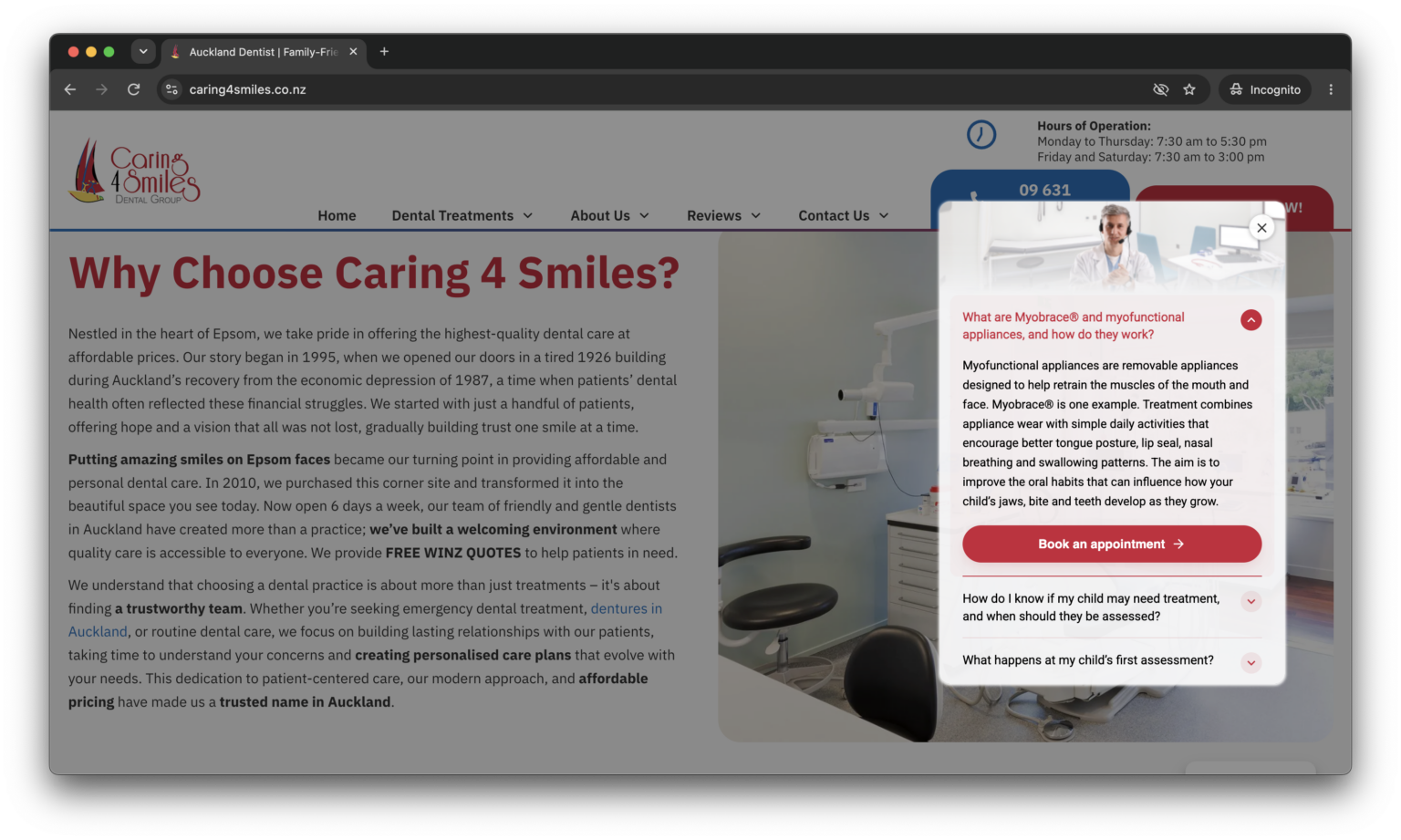
From 13 August to 12 September 2026, Pathmonk showed short microexperiences on the existing website. One helps visitors sort themselves by need: pain, children’s care, straighter teeth or a missing tooth. Another speaks to parents about breathing, oral habits, bite and jaw development. A third answers the questions parents ask before booking a child’s assessment. Every one ends in the same two actions, “Book an appointment” and “Call us”, so the route from interest to contact is one click.
The result was measured with an A/B test over the same dates. Traffic was split between a control group that saw the standard website (51%) and a Pathmonk group (49%). The comparison counts verified human visitors only, and on the Pathmonk side it counts the visitors who saw a microexperience. The goal was the same for both groups: a confirmed booking or a phone call.
Visitors who saw a microexperience converted at 36.76% against 20.06% in the control group, an uplift of 83.2% in booked appointments and phone calls. The Pathmonk group produced 75 bookings and calls from 204 verified visitors, and the control group 64 from 319. The difference builds through the visit: 80.4% of the Pathmonk group reached the consideration stage against 54.2% of the control group, and 46.6% reached the decision stage against 26.0%.
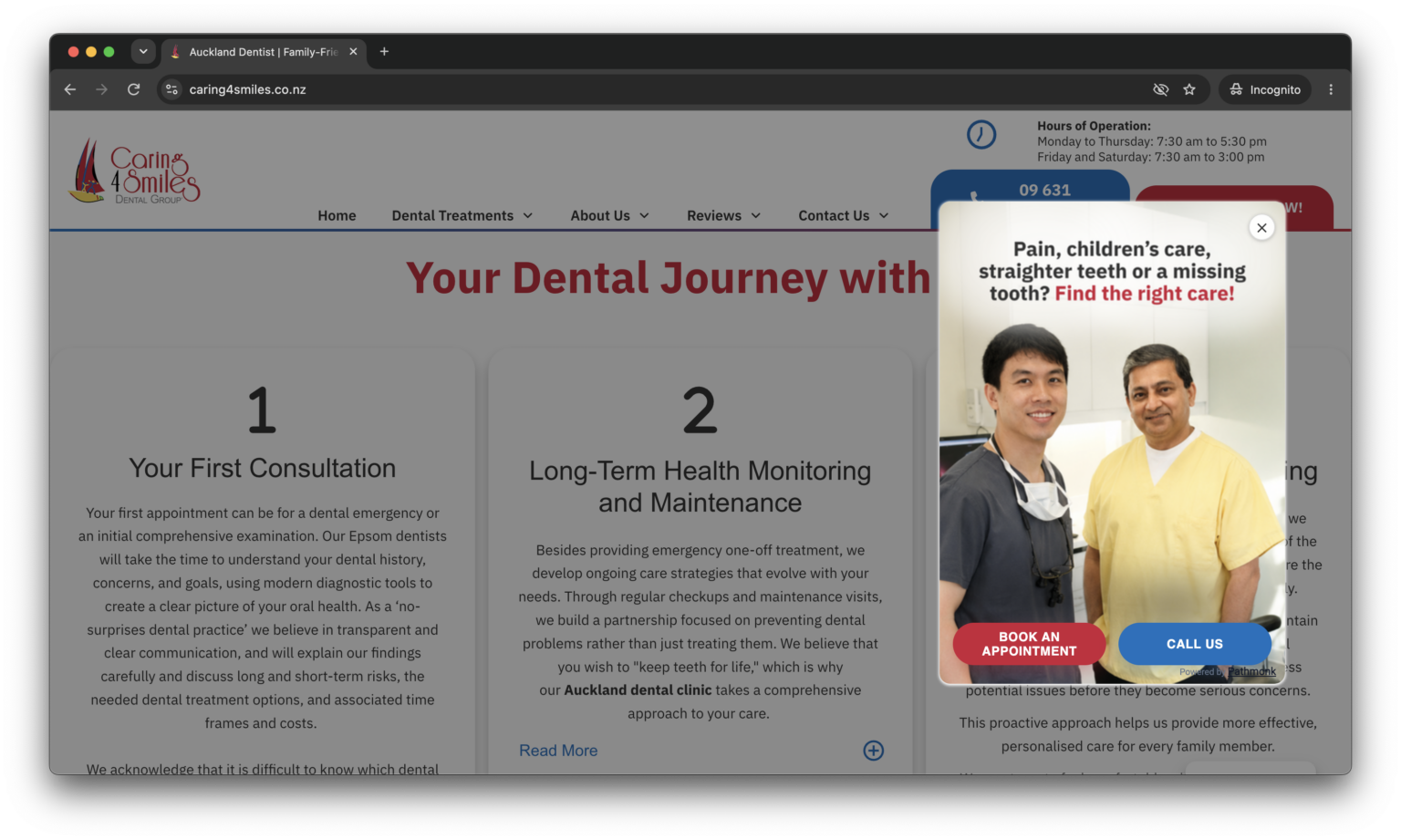
The three microexperiences line up with the three questions from the first section. Sorting by need answers “am I in the right place” for a first-time visitor. The message for parents and the answers before a child’s first assessment do the work of trust. And two buttons, book or call, keep the commitment small and leave the choice of channel to the patient.
“The results from our first month with Pathmonk are promising, and I am very excited about the content plan. It gives us full marketing freedom!” Dr. Loyola Correa, Caring 4 Smiles Dental Group.
The content plan Dr. Correa mentions is the second half of the clinic’s strategy: with the booking path working, it is now publishing articles for parents researching children’s mouth breathing, to bring more of the right visitors to a website that is ready for them. The case study reports the first traffic figures as early indicators.
The test goal counts a confirmed booking or a phone call, and the case study does not publish the two separately. By the definition used in this article a call is a step before the appointment, so the figure cannot show how many calls ended in a date and time. The groups are small, 319 and 204 verified visitors over one month, the Pathmonk side counts only visitors who saw a microexperience, and no confidence level is published. At a few hundred visitors a week the clinic sits just above the traffic floor described in the previous section. Read it as one clinic’s first month.
Key takeaways
- The largest loss on most clinic sites sits between the treatment page and the booking step, so measure that gap on its own.
- Before booking, a patient needs three answers: can I trust this clinic, what will it cost, and how much do I have to commit now.
- A first-time visitor from an ad and a returning visitor need different next steps on the same treatment page.
- Show a price range, what it includes and how it can be paid. If the price depends on an assessment, say so.
- Lead with proof anyone can verify. Check your own rules before using testimonials or before and after images.
- Match the booking step to the treatment: direct booking, a short consultation, and a phone option in view.
- An enquiry is a step before the appointment. Report it separately from booked appointments.
- Cost per booked appointment is spend divided by online and phone bookings from that spend. Leaving phone out overstates it.
FAQs on clinic appointment conversion
Why do visitors read our treatment pages and not book an appointment?
Usually because the page leaves one of three questions open: whether the clinic can be trusted, what the treatment is likely to cost, and how much the visitor has to commit to take the next step. Check the gap between treatment page views and booking step starts first, then fix whichever question the page does not answer.
Should a clinic website show prices?
Where your rules allow it, yes. A price range with what it includes lets a patient judge affordability without making contact, and payment options show how they would pay. If the price depends on an assessment, say that and state what the assessment costs.
Is online booking better than phone booking for clinics?
Offer both. In Experian Health’s 2025 survey, 80% of patients said they want to schedule appointments at any time from home or a mobile device, but some patients and some treatments still need a conversation. Count phone and online bookings together when you measure results.
Should the first step be a consultation or a direct booking?
Use direct booking when the patient can choose the treatment and its price without an assessment. Use a short consultation when the treatment plan or the price depends on an examination, and state the consultation price and length next to the button.
How do you calculate cost per booked appointment?
Divide the paid media spend for a period by the number of appointments booked by visitors from that spend in the same period, online and by phone together. Do not add enquiries to the count: an enquiry is a step before the appointment and only becomes a booking when a date and time are confirmed.
Can a clinic use patient testimonials and before and after photos?
It depends on where you practise and which body regulates you. Rules on testimonials and outcome images differ by country, regulator and profession, and some restrict or prohibit them. Check your own rules or ask your adviser before publishing; this article is not legal advice.
- Experian Health, State of Patient Access survey 2025 (press release, 28 April 2025) (experianplc.com). US survey of patients and providers.
- Zuko, form abandonment data by industry sector, 2025 (zuko.io). Vendor data from forms tracked by Zuko, accessed 5 October 2026.